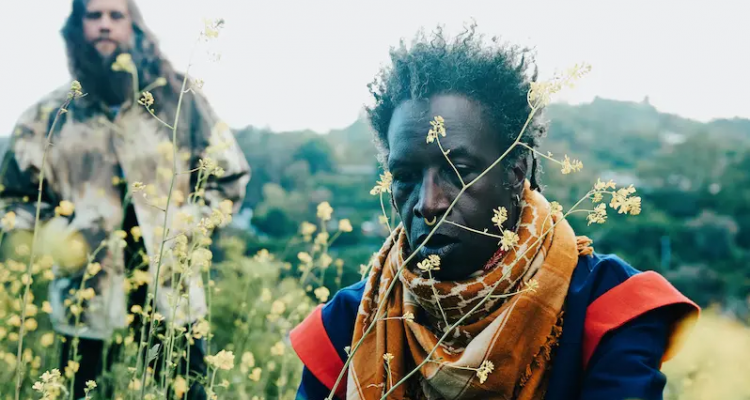
There’s a quietness in the stairwell of San Fran. I’ve climbed these steps a hundred times, but never in silence.
So I’m worried, as I reach the top. Has no one turned up to see Saul Williams and Carlos Niño? Or – and this seems more likely – have I arrived on the wrong night, or at the wrong venue?
But then I looked into the room, and I guess I smiled. Even though I’ve arrived at only a few minutes past 7.30pm, Williams, Niño and the band are already on, and the crowd is just…quiet. In the way that people get when they are transfixed and swept away by whoever is controlling the stage. Williams and Niño are that good.
I’ve been listening to Williams since a friend dropped List of Demands on a mixtape she’d made for me in about 2005. I bought the albums I could find – Niggy Tardust, MartyrLoserKing and the Neptune Frost soundtrack so far – and I learned Williams is one of the most urgent and indelible voices prowling in that American hinterland between slam, hip-hop, spoken word and pure activism. When he’s on fire, Williams is a writer and orator to stand beside James Baldwin – and he’s a musical architect and collaborator, with a gift for framing his voice in a way that makes any attempt at pinning him within a genre even more redundant than usual.
And yet, the Williams on stage at San Fran tonight is a million miles and a couple of decades away from the man I first fell in awe of. He’s seated, sipping a mug of tea, and will stay that way for the next hour. While the musicians alongside him – Carlos Niño and friends – are a muted accompaniment, flowing under and around the voice. They are present, insistent and every shade of gorgeous, but never the pile-driver I’d half expected – and maybe hoped for.
But fuck, this is a mesmerising gig. Williams is flying as I find a patch of wall to lean against, and I fall under the spell he has already cast on the room with a long soliloquy on the true history of the island of Manahatta (we call it Manhattan today) – and the destruction of the Lenape people who had lived there for centuries.
I’d heard this history before. Or read it on a plaque maybe. But I had never been invited to contemplate its rhythms and stare dumbly across the plains of time, to when decisions were made that we still live, literally, on top of. With Niño carving swathes of colour out of the air beside him, Williams makes the story comes alive in the room. Events of 500 years ago are suddenly as recognisable and relevant as today’s headlines. Later, excerpts from Coltan as Cotton get woven in to a reconstruction of We Are Calling Out In This Moment. A shimmering We Would Lift Our Voice gets stripped back and reimagined for this night.
“I’ve seen enough” says Williams. “I’ve seen enough”.
Williams doesn’t stoop to explain his pieces, or to tell us “what it means”. He just removes the option from our lives that we could ever pretend again that we didn’t know these truths. For an hour or so we are a little more conscious of the world. What we do with that consciousness, after he leaves the stage, is up to us.
Walking home, I felt humbled, uplifted, challenged and embraced. Williams is a seer, in the truest sense, and a writer who can graft muscle and skin onto the bones of history, and send it dancing out into the night. If he makes his way to Aotearoa again, make sure that you are there.
Ake Ake Ake. Kia Kaha E!
– Graeme Trouble.